The Rope - Part 6: Woven Metal and the Conquest of the Skies and Seas
·773 words·4 mins
A look at how wire rope transformed the world as we know it. From bridges to the first transatlantic cables and the first man on the moon.
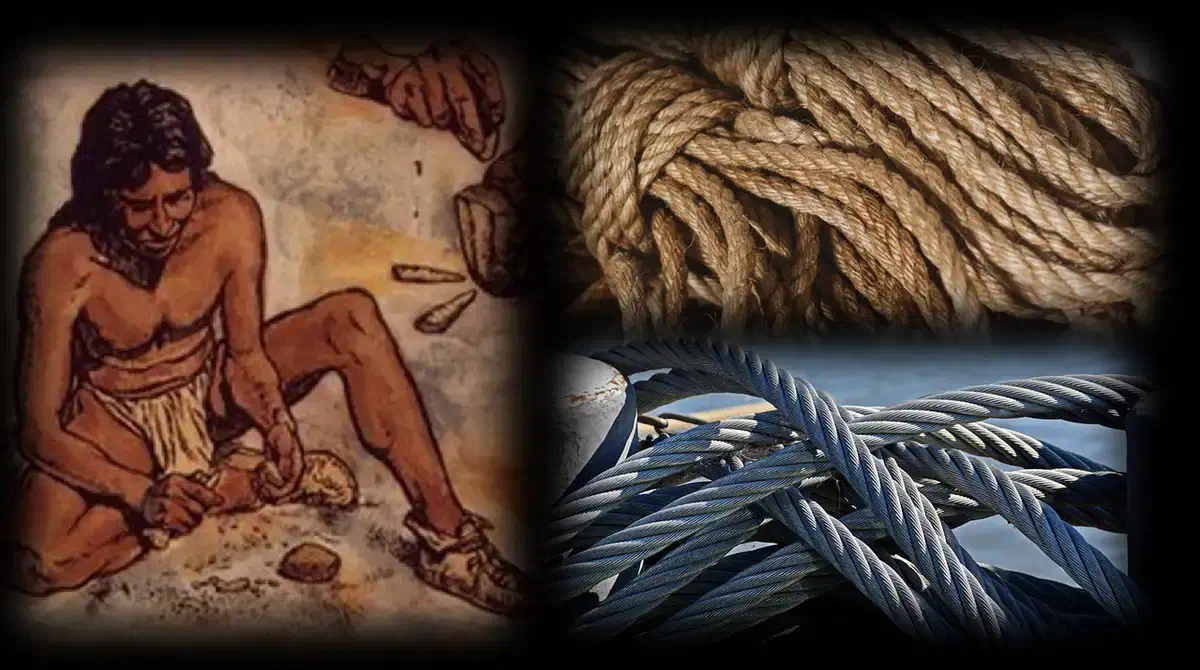
The history of human progress is frequently narrated through the mastery of hard materials like bronze, iron, and silicon. Yet a thorough analysis of human technological evolution reveals that our capacity to project force, organize massive labor pools, and traverse hostile environments depended almost entirely on a highly engineered soft technology. Rope, constructed first from twisted plant fibers and eventually from drawn steel and synthetic polymers, served as the indispensable connective tissue of the modern world. This series will explore this foundational technology, detailing how the simple helix transformed human capability from the Paleolithic era to the vanguard of space exploration.
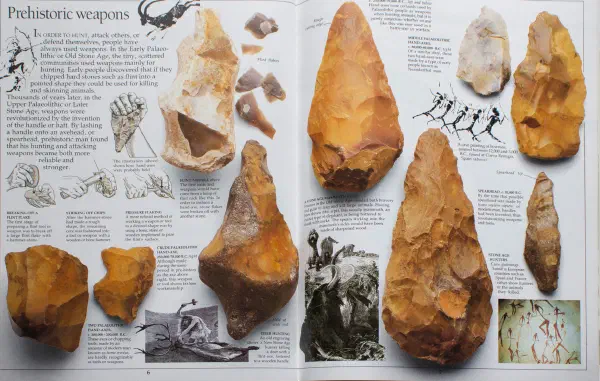
The series commences by examining how the invention of cordage fundamentally altered the tactical geometry of prehistoric survival. The ability to twist fibers together allowed early humans to lash sharpened flint to wooden shafts, creating the spear and subsequently the bow and arrow. This development provided a critical standoff capability, allowing hunters to project lethal kinetic energy from a safe distance, significantly reducing the risk of catastrophic injury.
The cognitive leap required for this invention was profound. Microscopic analysis of a fifty thousand year old rope fragment found in a French cave inhabited by Neanderthals reveals a sophisticated three-strand architecture. Creating this alternating structure, utilizing opposing rotations known as the S twist and Z twist to maximize internal friction, required an innate grasp of mathematical sets and abstract numerosity. By the time early engineers in Germany carved specialized ropemaking tools from mammoth tusks to systematize production, humanity had successfully mechanized the twisting process, laying the groundwork for proto-industrial efficiency.
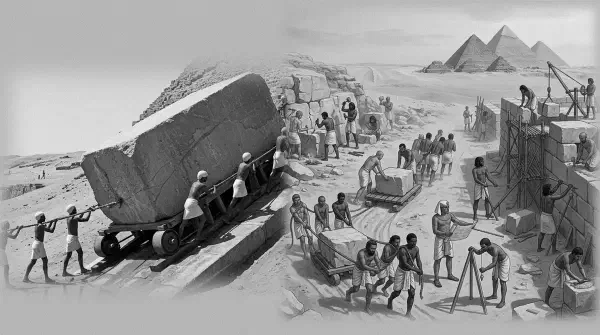
The second installment investigates the role of rope as the ultimate force multiplier in the ancient world. The construction of antiquity's megastructures required a mechanism to concentrate the muscle power of thousands of laborers onto a single immobile object. Rope provided this exact function. During the construction of the Egyptian pyramids, massive limestone and granite blocks were hauled using thick cords manufactured from halfa grass, papyrus, and date palm fibers. Some theorists propose these stones were moved using rope rolls, which acted as primitive single block pulleys to pull the stones up the slanted sides of the monument.
The Romans later applied immense logistical rigor to relocate Egyptian obelisks, utilizing towering gantry cranes equipped with heavy ropes and multiple winches driven by hundreds of men and horses. Similarly, the architects of Stonehenge relied on immense tow lines, potentially braided from the fibrous inner bark of the lime tree, to drag multiton monoliths across the British landscape.
The third article shifts focus to the maritime domain, demonstrating how global navigation and naval warfare were entirely dependent on advanced cordage. In the Mediterranean, Egyptian shipwrights used grass ropes threaded through internal wooden channels to literally stitch their hull planks together. In the Pacific, Austronesian voyagers utilized highly water resistant coconut fiber to lash their catamaran canoes, achieving a yielding hydrodynamic architecture that absorbed the dynamic stress of ocean swells better than rigid modern fasteners.
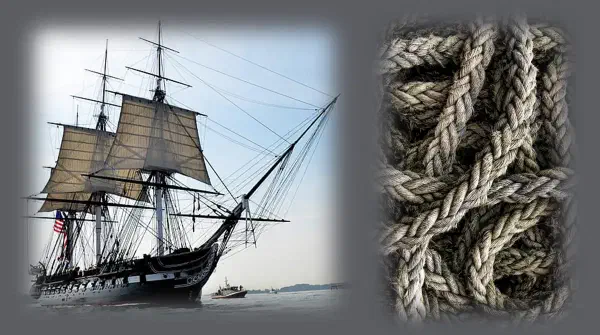
The apex of rope reliant naval engineering arrived with the European square rigger. These multi masted floating engines required miles of tarred hemp for standing rigging to support the masts, and complex running rigging to articulate the sails. The strategic value of this cordage was perfectly illustrated during the War of 1812, when the crew of the American frigate USS Constitution spliced together nearly a mile of heavy rope to drag their becalmed ship away from a pursuing British squadron in a grueling mechanical maneuver known as warping.
The fourth piece explores the profound cultural, spiritual, and administrative weight carried by twisted fibers. The physical binding properties of rope naturally translated into powerful symbols of unity and control. In the Roman Republic, brides wore a belt fastened with a Hercules knot, symbolizing the capturing of procreative power. In medieval Europe, the capacity of knots to bind led to the superstitious belief that individuals could capture storm winds in knotted cords.
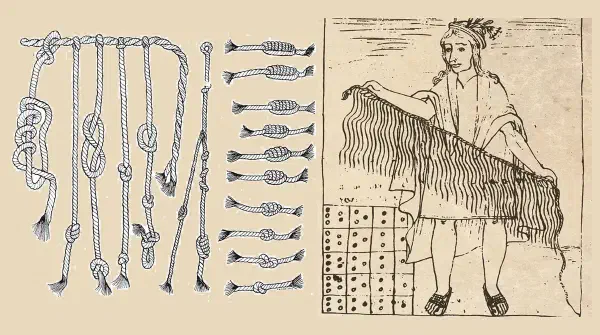
However, the most sophisticated non physical application of rope occurred in the Inca Empire. Lacking a written alphabet, Incan administrators utilized a highly advanced three dimensional information storage system known as the khipu. By manipulating the color, material, and precise knot placement on suspended animal and cotton cords, the Inca encoded complex census data, accounting ledgers, and narrative histories.
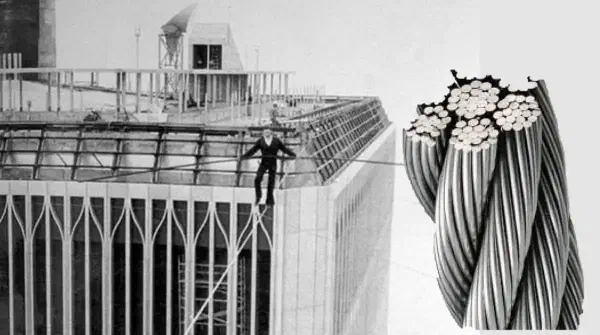
The fifth article documents the crucial transition from organic plant fibers to drawn metal. In the 1830s, a German mining engineer named William Albert realized that twisting iron wires into strands and ropes offered vastly superior load capacity compared to rotting hemp or brittle iron chain. This metallurgical breakthrough rapidly migrated to the United States, where engineer John Roebling replaced expensive hemp hawsers on the Allegheny Portage Railroad with his own wire rope.
The immense tensile strength of woven steel subsequently enabled Roebling to design the Brooklyn Bridge, utilizing main suspension cables fifteen inches in diameter. Wire rope also formed the indispensable protective armor for the first transatlantic telegraph cables, shielding the delicate copper and gutta percha core from the abrasive ocean floor and inaugurating the era of instant global communication.
The final installment chronicles the mid twentieth century revolution of synthetic polymers and the futuristic applications of advanced tensile materials. In 1935, DuPont chemist Wallace Carothers bypassed agricultural limitations by synthesizing nylon from petroleum. Nylon possessed incredible elasticity, a property that proved vital during the D-Day invasion when it was used to safely absorb the immense kinetic shock of towing heavy troop gliders into the air.
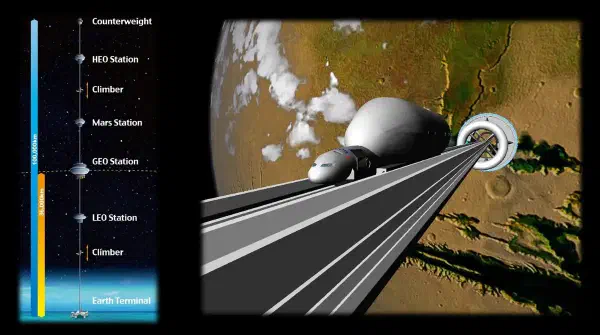
The subsequent development of high modulus synthetic fibers, such as the Kevlar invented by Stephanie Kwolek, yielded materials five times stronger than steel. NASA relied on these advanced aramid fibers, specifically Technora and Kevlar, to successfully parachute the one ton Curiosity rover onto the surface of Mars. The series concludes by looking toward the ultimate application of linear strength: the space elevator. To construct a tether stretching 62,000 miles from the Earth's equator into space, physicists point to Graphene Super Laminate, a material assembled from atomically thin layers of carbon capable of withstanding the immense mechanical stress required to lift payloads into orbit without the use of explosive rockets.
Barber, E. W. (1994). Women's work: The first 20,000 years. W. W. Norton. This text provides foundational insights into the String Revolution, exploring how the invention of twisted fibers allowed early humans to tame their environment through the creation of snares, nets, and tethers, fundamentally altering human interaction with the physical world.
Casson, L. (1991). The ancient mariners: Seafarers and sea fighters of the Mediterranean in ancient times. Princeton University Press. Casson's work offers essential historical context regarding the maritime dominance of ancient civilizations, detailing how advanced rigging and structural cordage systems, such as the heavy rope hawsers used on Greek triremes, enabled early naval warfare and global power projection.
Day, C. L. (1967). Quipus and witches' knots: The role of the knot in primitive and ancient cultures. The University of Kansas Press. This comprehensive study is vital for understanding the dark magic and superstition associated with cordage, documenting cultural practices such as the European folklore surrounding wind knots and the belief that individuals could capture storms to sell to becalmed seafarers.
Fitchen, J. (1961). The construction of Gothic cathedrals: A study of medieval vault erection. The University of Chicago Press. Fitchen's architectural analysis explains the immense logistical requirements of erecting medieval megastructures, highlighting the indispensable role of rope in lashing together wooden scaffolding and operating the massive treadwheel cranes necessary for hauling multiton stones skyward.
Gaines, A. (2002). Wallace Carothers and the story of DuPont nylon. Mitchell Lane Publishers. This biographical and scientific history chronicles the synthesis of polyamide polymers from petroleum, marking the critical transition from agricultural fibers to the high strength synthetics that absorbed massive kinetic shocks during military glider operations and transformed modern aerospace logistics.
Hardy, B. L., Moncel, M. H., Kerfant, C., Lebon, M., Bellot Gurlet, L., & Melard, N. (2020). Direct evidence of Neanderthal fibre technology and its cognitive and behavioral implications. Scientific Reports, 10, Article 4889. Providing hard archaeological evidence from the Abri du Maras cave, this scientific paper underpins the argument that Neanderthals possessed the advanced numeracy and abstract reasoning skills required to manufacture three strand cordage over fifty thousand years ago.
Hersch, K. K. (2010). The Roman wedding: Ritual and meaning in antiquity. Cambridge University Press. Hersch provides a detailed look at the spiritual and symbolic weight of knots in antiquity, specifically examining the Hercules knot worn by Roman brides as a representation of procreative power and marital union.
Houdin, J. P. (2006). Khufu: The secrets behind the building of the Great Pyramid. Farid Atiya Press. This text is instrumental in demystifying the engineering mechanics of the ancient Egyptian pyramids, presenting theories on how vast networks of laborers utilized advanced ropemaking and internal spiral ramps to haul massive limestone blocks up the monuments.
Hyland, S. (2017). Writing with twisted cords. Current Anthropology, 58(3), 412-419. Hyland's anthropological research decodes the sophisticated three dimensional information storage system of the Incan khipu, revealing how precise knot placements encoded complex census data, accounting ledgers, and potentially narrative epistles about warfare.
McCullough, D. (1972). The great bridge: The epic story of the building of the Brooklyn Bridge. Avon Books. McCullough's narrative captures the industrial leap from organic hemp to woven metal, detailing the engineering triumphs and lethal dangers involved in spinning the massive steel wire ropes that suspended the Brooklyn Bridge.
Morison, S. E. (1950). The ropemakers of Plymouth: A history of the Plymouth Cordage Company, 1824-1949. Houghton Mifflin Company. This history illustrates the nineteenth century industrialization of ropemaking, documenting the shift from manual labor in thousand foot ropewalks to mechanized, steam powered factories driving the global maritime apparatus.
Pitts, M. (2022). How to build Stonehenge. Thames and Hudson. Pitts examines the logistics of the British Bronze Age, exploring theories that ancient builders utilized braided bast fiber or hazel withies to drag colossal sarsen stones and bluestones across the Salisbury Plain.
Plymouth Cordage Company. (1916). The story of rope: The history and modern development of rope-making. Plymouth Cordage Company. As a primary source from the era of industrial expansion, this document provides technical insights into the machinery and processes that systematized cordage production, ensuring the reliable mass manufacture required by the merchant and whaling fleets of the early twentieth century.
Raitt, D. (Ed.). (2017). Space elevators: A history. ISEC. Raitt's compilation looks to the absolute frontier of aerospace logistics, outlining the theoretical and materials science framework necessary for constructing a space elevator tether utilizing atomically thin graphene super laminates.