
The evolution of human security and technological dominance is frequently chronicled through the mastery of hard materials, moving from fractured flint to forged iron. Yet this traditional narrative overlooks a softer but equally revolutionary innovation that fundamentally altered how early humans interacted with their environment. Rope, arguably humanity's first true appliance, was the critical connective tissue that allowed our ancestors to organize reality.
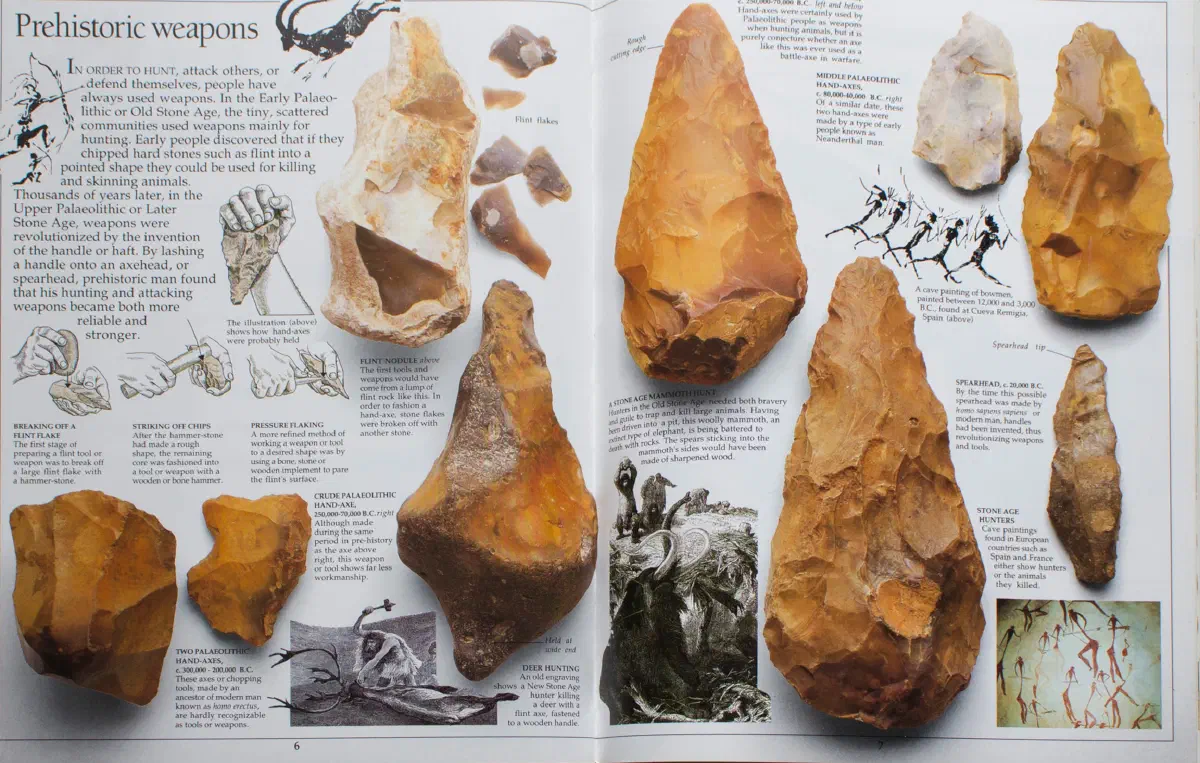
Long before communities engineered fortifications or complex logistics chains, survival depended on managing the immediate tactical geometry of the hunt. Early stone tools, such as the ubiquitous hand axe, required close quarters engagement, a highly dangerous proposition. The technological leap to sharp flint flakes provided lighter, deadlier blades, but these components were useless in isolation. It was the invention of twisted cordage that allowed early engineers to lash a sharpened flint flake to a wooden shaft, thereby creating the spear.
This synthesis of materials via cordage eventually produced the bow and arrow, a development that gifted Stone Age hunters with their first true standoff weapon. By storing potential energy in a bent stick and releasing it as kinetic energy through a taut string, a group of hunters could project lethal force against a two thousand pound wild aurochs from a safe distance, drastically reducing the risk of catastrophic injury. The ability to bind, tether, and project force at a distance proved so transformative that archaeologists have dubbed this era the String Revolution.
Neanderthal Numeracy at Abri du Maras#
Because plant and animal fibers decompose rapidly, physical evidence of prehistoric cordage is exceedingly rare. However, a remarkable 2019 discovery at the Abri du Maras cave site in southeastern France has provided a tangible link to this ancient technological leap. While excavating an area known to have been inhabited by Neanderthals, a team led by Dr. Marie-Hélène Moncel preserved flint specimens in sealed plastic bags to prevent contamination. Anthropologist Dr. Bruce Hardy later analyzed these untouched tools in Paris, noticing what appeared to be twisted fibers adhering to the base of a sixty millimeter long flint flake.
To demystify the microscopic tangle, researchers employed both optical and scanning electron microscopes capable of resolving details down to a single nanometer. The imaging revealed a fifty thousand year old fragment of true rope, definitively proving that Neanderthals possessed sophisticated manufacturing capabilities long before modern humans dominated the continent.
This was no simple strip of twisted bark. The specimen exhibited the distinct architectural hallmarks of a three-strand rope, utilizing opposing rotational forces known as the S twist and the Z twist. To construct such a rope, a maker must first twist raw fibers counterclockwise into three separate yarns, a configuration called an S twist. If these yarns were simply grouped together, they would quickly unravel. To prevent this, the ropemaker twists the three completed yarns together in the opposite, clockwise direction, known as a Z twist.
This alternating geometry is an elegant engineering solution. The opposing twists place the elements in tension with one another, utilizing friction and mechanical interlocking to bind the structure. Furthermore, the twisting forms a helix. When a pulling force is applied, the helical structure tightens inward, locking the strands more firmly together, much like a cord wrapped loosely around a human forearm will suddenly constrict and grip the skin when pulled from one end.
The Cognitive Leap#
The Abri du Maras discovery forces a profound reassessment of Neanderthal intellect. The design and execution of three-strand cordage is not an accidental byproduct of idle hands. As researchers noted in the journal Nature, the production of such a tool requires a detailed understanding of plant seasonality, systematic planning, and complex sequential processing.
More importantly, it requires an innate grasp of mathematical concepts and general numeracy. To build a stable three-strand rope, the maker must conceptualize pairs of numbers and sets of elements. The mind must hold the abstract blueprint of the final product while simultaneously managing the opposing helical twists of its constituent parts. This capacity to leverage finite materials to achieve infinite structural uses demonstrates a level of cognitive complexity previously thought to be exclusive to modern human language and symbolic thought. The Neanderthal was not a brutish cave dweller, but a calculating artisan capable of abstract reasoning.
Mechanizing the Twist#
Having mastered the intellectual and physical mechanics of cordage, early humans quickly sought to optimize its production. Hand twisting is a laborious, time consuming process that strictly limits the output of usable rope. The drive toward proto-industrial efficiency is perfectly illustrated by a discovery at the Hohle Fels cave in southwestern Germany, a site famous for yielding thirty-five thousand year old figurative art.
In 2020, an archaeological team led by Dr. Nicholas Conard unearthed a carved mammoth tusk dating back forty thousand years. Unlike the artistic figurines found previously, this tusk was distinctly utilitarian, featuring four bored holes with scored, angled cuts radiating from the edges. Conard and Belgian archaeologist Dr. Veerle Rots identified the artifact as a specialized ropemaking tool.
By feeding individual lengths of raw plant fiber through the four precisely aligned holes and spinning the entire heavy tusk, a single operator could twist four strands of grass around one another simultaneously. This bypassed the complex and fatiguing hand motions required to maintain tension and twist direction, effectively mechanizing the creation of four-strand rope. This mammoth tusk represents humanity's earliest known attempt to systematize and accelerate manufacturing. By transitioning rope from a bespoke, hand crafted item to a reliable, mass produced utility, these early engineers laid the indispensable groundwork for the massive collaborative megaprojects that would soon come to define human civilization.