
Roping Antiquity: The Megastructures of the Ancient World#
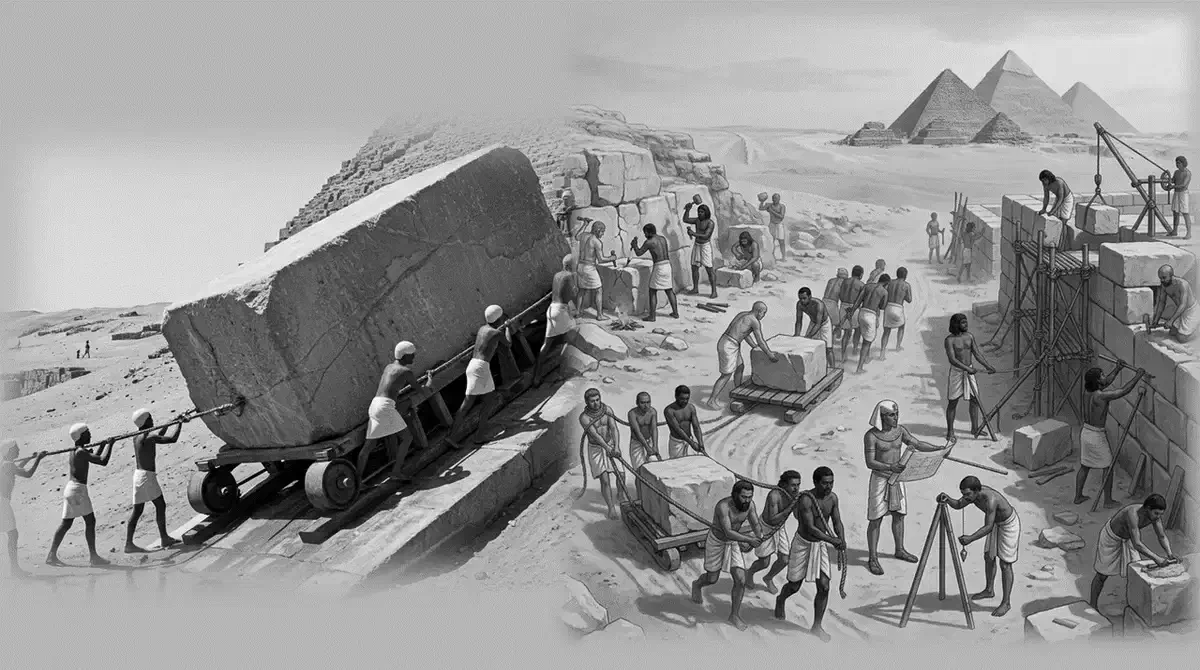
Human progress is frequently measured by the mastery of hard materials, but stone is entirely immobile without a mechanism of transport. To build the ancient world's monuments, early states needed a technology that could harness and concentrate the kinetic output of thousands of laborers. Rope provided this exact function, serving as the essential connective tissue that enabled mass human action. A two and a half ton limestone block can only accommodate the hands of a few individuals pushing it, but wrapping a thick rope around that same block allows hundreds of workers to apply their combined physical strength. Rope effectively functioned as a force multiplier, transforming scattered laborers into a unified industrial engine.
The Pyramids and the Mechanics of Mass Hauling#
In Egypt, the construction of seven major pyramids between roughly 2600 and 2300 BCE relied heavily on advanced cordage. The ancient Egyptians were master ropemakers who utilized halfa grass, papyrus fibers, date palm fibers, and even animal hide to manufacture their lines.
The precise logistics of lifting limestone blocks up the rising monuments remain fiercely debated, with many archaeologists favoring the use of massive earthen ramps. A more mechanically elegant theory proposed by Franz Löhner suggests the builders used the fifty two degree slanted sides of the pyramids themselves as hauling tracks. By lashing spinning wooden shafts, known as rope rolls, to the upper courses of the pyramid, workers could route their hauling ropes up the side, around the shaft, and back down to the ground. This primitive single block arrangement meant laborers could haul the stones upward by walking downward, letting gravity assist their muscular effort.
Engineering the Obelisks#
The Egyptians applied similar logistical rigor to their obelisks, towering monuments carved from red granite quarried in Aswan. The largest of these, erected for Pharaoh Thutmose III, weighed approximately five hundred tons. Erecting such a monolith without modern hydraulics likely required building a mud brick ramp that terminated over a sand filled pit. Ropes were used to drag the obelisk up the ramp until its base rested on the sand. Workers would then drain the sand away, causing the stone to tilt downward onto its foundation before hauling teams used ropes to pull it to a fully upright position.
Centuries later, the Romans and their successors became obsessed with moving these monuments, relying on colossal rope systems. When architect Domenico Fontana relocated an eighty four foot obelisk to St. Peter's Square in Vatican City in 1586, he deployed a ninety foot gantry crane equipped with forty winches. These winches were spooled with ropes almost three inches in diameter and over seven hundred feet long. It required the coordinated effort of nine hundred men and seventy five horses just to lower the massive stone safely.
Stonehenge and the British Bronze Age#
While the Egyptians were raising pyramids, Bronze Age Britons were dragging colossal stones across the Salisbury Plain to construct Stonehenge, a project begun around 2600 BCE. The logistics of this monument involved hauling one to two ton bluestones from quarries in Wales over one hundred and forty miles away, and much heavier sarsen stones from a site sixteen miles distant. Researchers estimate that moving and erecting the largest stones required the coordinated muscle power of up to four thousand people.
The cordage required for this feat was manufactured from local flora, as plant based rope provided immense pulling capacity. Archaeological finds suggest the builders may have utilized braided hazel withies or rope twisted from lime bast, which is the fibrous inner bark of the lime tree. A three strand rope made from bast fiber could withstand hundreds of pounds of tension, and braiding multiple cords together yielded a tow line entirely capable of dragging multiton monoliths across the damp British landscape. Whether hauling Welsh granite or Egyptian limestone, the architectural wonders of antiquity owe their existence to the mechanical genius of twisted fiber.