
Binding the Seas: Rope and the Architecture of Global Navigation#
The mastery of the oceans is often attributed to the evolution of navigation, the charting of celestial bodies, and the relentless pursuit of spices and empires. Yet the physical reality of maritime dominance rested entirely upon a softer technology. Without rope, the vessels that connected the ancient and modern worlds could neither be built, steered, nor sustained. To understand the history of shipbuilding and naval warfare is to understand how engineers across millennia utilized twisted fibers to harness wind, articulate hulls, and secure strategic advantage.
The Egyptian Shell First Synthesis#
In the Mediterranean, the ancient Egyptians approached the engineering of watercraft through a method distinct from later European practices. Rather than constructing an internal skeleton of a keel and ribs to support an outer skin, Egyptian shipwrights built their vessels from the outside in. This method relied on carvel planking, where heavy wooden boards were fitted flush against one another to form the hull.
To achieve longitudinal stability, the builders cut mortises into the edges of adjacent planks and inserted wooden tenons, mechanically preventing the boards from sliding forward or backward. However, a ship at sea faces immense lateral and torsional stresses. To keep the seams pressed tightly together, the Egyptians turned to advanced cordage, literally stitching their ships into existence.
The mechanical brilliance of this system lay in its execution. Shipwrights carved V shaped channels into the interior faces of the hull planks. They then threaded ropes manufactured from halfa grass through these channels, pulled them under high tension, and tied them off. Because these structural lashings were restricted entirely to the interior of the vessel, they were invisible from the outside. This elegant design eliminated the need for external holes that would invite leaks and protected the vital structural ropes from being chafed away when the vessel grounded on a beach or rested against a stone quay. Bolstered by transverse wooden frames that were similarly lashed into place, these highly capable ships navigated the Mediterranean and ventured down the Red Sea to trade for gold, ivory, and frankincense.
Pacific Expansion and the Physics of Flexibility#
As the Egyptians dragged limestone along the Nile, an entirely different maritime revolution was taking shape in the Pacific. Beginning around 3000 BCE, Austronesian voyagers departed Taiwan, initiating a staggering oceanic expansion that would eventually reach from Madagascar to Easter Island.
The vessels that enabled this diaspora were catamaran and outrigger canoes lashed together not with grass, but with coir. Coir is a fiber extracted from the hairy husk of the coconut. Because it possesses an exceptionally high lignin content, coir cordage is virtually waterproof and resists the corrosive effects of salt water better than almost any other natural material.
The use of rope in these Pacific vessels provided a crucial hydrodynamic advantage. Traditional Western boatbuilding relies on rigid metal fasteners that can shear or fracture under the immense, cyclic loads of ocean swells. A Polynesian voyaging canoe, bound entirely by vegetable fibers, retained a calculated degree of flexibility. As the twin hulls rode over chaotic wave trains, the rope lashings allowed the components to work against each other, absorbing and dissipating dynamic stress. This yielding architecture meant that a traditional catamaran caught in a violent nighttime squall was often less at risk of catastrophic structural failure than a rigidly fastened modern vessel.
The Industrial Machine of the Square Rigger#
Naval architecture underwent a profound shift between the fifteenth and nineteenth centuries. The oar powered galleys that had dominated the Mediterranean for millennia were light and shallow, rendering them entirely unsuited for the towering rollers and fierce weather of the open Atlantic. Global power projection required a transition to wind driven ships, leading to the development of the multi masted square rigger.
These ships functioned as colossal floating engines, capturing kinetic energy from the wind through an ever expanding vertical array of canvas. Above the massive lower courses, shipwrights stacked topsails, topgallants, royals, and skysails, culminating in rigs that resembled floating skyscrapers.
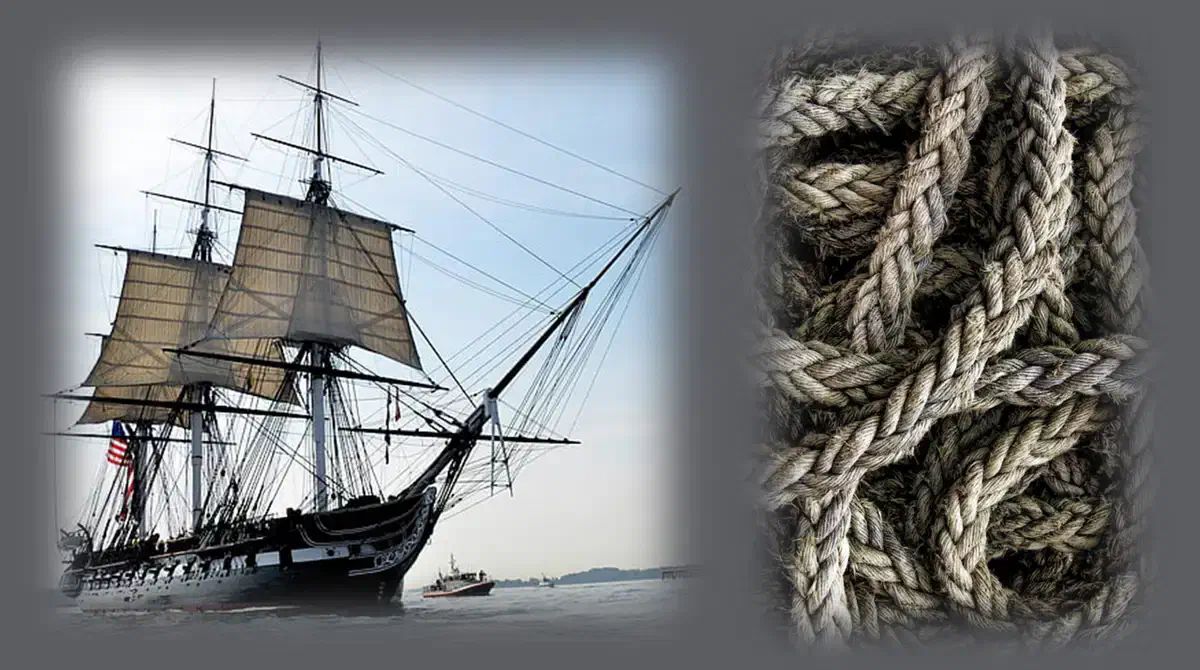
Controlling this immense power required an industrial volume of rope divided into two distinct systems. The running rigging consisted of the lines used to raise, lower, and trim the sails. Operating this bewildering web of cordage required sailors to possess an encyclopedic spatial memory, enabling them to find and haul the correct line in the pitch dark of a squall or amidst the chaos of incoming artillery fire.
The second system, the standing rigging, bore the static load of the towering composite masts. Without the lateral support of rope shrouds and fore and aft stays, the masts would collapse under the sheer force of the wind. This presented a distinct engineering problem. The preferred material of the era was hemp, which possessed prodigious tensile strength but was highly susceptible to moisture. If the inner core of a hemp rope became wet, it effectively composted from the inside out, silently destroying the structural integrity of the ship. To waterproof the standing rigging, ropemakers saturated the fibers with boiling pine tar.
Furthermore, hemp elongates under sustained tension. A taut shroud would inevitably sag over time, jeopardizing the mast. The solution was a tensioning device known as a deadeye, a solid wooden block pierced with holes. By threading a smaller rope, called a lanyard, back and forth between two deadeyes, sailors created a mechanical purchase. When the standing rigging stretched, crews would attach the lanyard to a block and tackle system, hauling in unison to cinch the shroud tight once again. The scale of this rope reliant architecture was staggering. In 1847, outfitting the USS Pennsylvania, a three decked ship of the line, required more than thirteen miles of hemp cordage.
Strategic Warping and the Escape of the Constitution#
The tactical application of this technology is perfectly encapsulated by an incident early in the War of 1812. In July of that year, the American frigate USS Constitution found herself pursued by a squadron of five British warships off the coast of New Jersey. Outgunned by a combined two hundred and eight cannons, Captain Isaac Hull had no choice but to flee.
As the chase unfolded, the wind died completely, robbing the Constitution of her primary propulsion. Hull initially deployed his crew in small boats to row the heavy frigate forward, but the British countered by concentrating their own rowboats to tow their lead ship, the Shannon, rapidly closing the distance.
To avoid annihilation, Hull and his First Lieutenant, Charles Morris, resorted to a grueling mechanical procedure known as warping. The ocean floor lay one hundred and fifty six feet below them. Dropping an anchor at that depth to pull a ship forward requires an exceptionally long line to ensure the anchor digs into the seabed rather than simply being pulled straight upward. Morris frantically ordered his crew to splice together every piece of heavy hawser and rigging line aboard, assembling a continuous cable measuring nearly a full mile in length.
The crew rowed a small kedge anchor out to the absolute limit of this massive rope and dropped it to the bottom. On the deck of the Constitution, sailors manned the heavy capstan, physically winching the enormous warship across the glassy water toward the anchor. Once the ship reached the drop site, the anchor was hauled up, rowed forward again, and the grueling cycle repeated. The American crew maintained this staggering output of physical labor for fifty seven continuous hours.
When a breeze finally materialized on the third day, the Constitution had preserved just enough distance to set her sails and slowly pull away from the exhausted British squadron. Without the capability to synthesize and deploy a mile of heavy cordage under extreme duress, the famed American vessel would have been captured or destroyed. In the Age of Sail, rope was not merely a construction material, it was the fundamental instrument of survival and strategic mobility.