
Although the initial series outline concluded with five articles, the history of cordage contains another crucial revolution that demands exploration. The transition from organic plant fibers to woven metal fundamentally reshaped modern infrastructure, global communications, and even aerial entertainment.
Forging Cordage from Iron#
The idea of twisting metal wire into rope originated in the mining pits of Germany during the early nineteenth century. In the Harz Mountains, miners relied on hemp rope and iron chain to raise heavy buckets of excavated material. Both materials possessed severe limitations, as the damp environment quickly rotted hemp fibers, while iron chains were prone to sudden, catastrophic failure if a single link broke.
In the 1830s, an engineer named William Albert realized he could combine the parallel load-bearing structure of hemp rope with the superior tensile strength of iron. Albert experimented by hand-twisting four lengths of wrought-iron wire into a strand, and then twisting three identical strands together to form a complete rope. When tested in a mine shaft nearly 1,600 feet deep in 1834, Albert's invention boasted six times the load capacity of a hemp rope of the same diameter. This innovation ensured that if an individual wire broke, the overall structure would merely lose a fraction of its strength rather than failing entirely.
From Portage Railroads to the Brooklyn Bridge#
The migration of wire rope to the United States began with portage railroads, which were systems designed to haul canal barges over mountainous terrain using railcars. On the Allegheny Portage Railroad in Pennsylvania, stationary steam engines pulled flatcars using massive Kentucky hemp ropes that cost nearly three thousand dollars and stretched over a mile in length. Because these expensive hemp hawsers frayed and failed frequently, an engineer named John Roebling proposed replacing them with wire rope. Roebling manufactured the first test rope on his own farm, successfully proving the concept and launching a massive commercial enterprise.
Roebling's mastery of wire rope culminated in the design of the Brooklyn Bridge, a suspension bridge relying on main cables fifteen inches in diameter, built from countless yarns of steel. The immense power of these metal ropes was tragically demonstrated during the construction of the bridge in 1878. While workers were attaching a massive steel strand under seventy-five tons of tension, a wire fall rope used to inch the strand forward suddenly snapped. The recoiling strand shot across the river with the sound of a rocket, severing a telegraph pole and taking the lives of two workers. Despite the tragedy, the bridge opened in 1883 as the longest suspension bridge in the world.
Transatlantic Telegraph Cables#
Wire rope also enabled the first instant communication across oceans. In the mid-nineteenth century, ambitious entrepreneurs sought to lay a telegraph cable across the Atlantic Ocean from Ireland to Newfoundland. The required cable was a composite masterpiece, featuring a central copper conductor coated in gutta-percha latex. To protect this delicate core from the harsh ocean environment and sharp rocks, it was wrapped in layers of tarred hemp and encased in an outer armor of eighteen strands of iron wire.
The physical weight of the required cable was staggering. Early attempts in 1857 and 1858 utilized naval ships to carry the massive load, but the cable snapped multiple times and a successful connection ultimately failed after only a few weeks. By 1865, the operation required the largest ship in the world, the paddlewheel steamship Great Eastern, to carry all 2,300 miles of the improved cable in specialized water tanks. After another broken cable and a subsequent recovery mission that used twenty miles of galvanized iron wire rope to dredge the sea floor, the project succeeded in 1866, permanently connecting North America and Britain.
A Ribbon in the Sky#
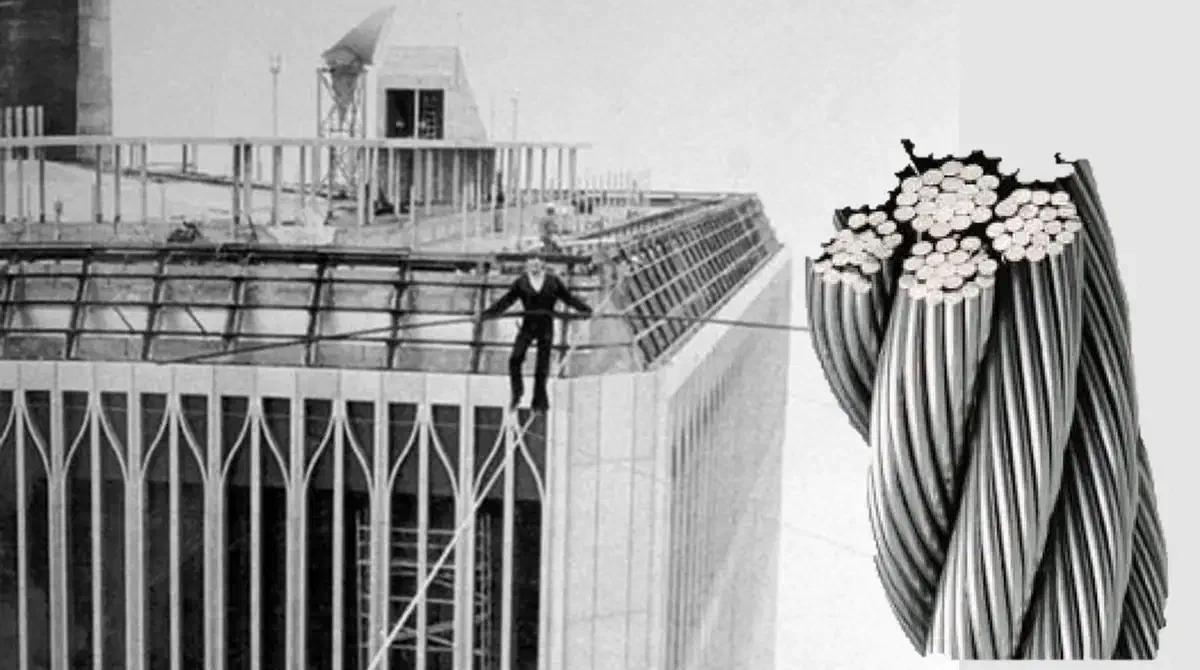
Beyond its industrial applications, wire rope has served as the foundation for breathtaking human spectacle. In 1974, a French high-wire artist named Philippe Petit utilized a steel rope to walk across the 138-foot void between the World Trade Center towers in New York City. The clandestine operation required secretly transporting a two hundred foot long, three-quarter-inch steel rope weighing over 250 pounds to the top of the South Tower.
Because the wire rope was far too heavy to carry across the gap directly, Petit and his team used a bow and arrow to shoot a monofilament fishing line across the chasm. They used this thin line to pull progressively thicker cords across the space, eventually pulling the heavy steel cable into place. Once the wire rope was secured and tensioned with a winch, Petit stepped out onto the steel strands, walking 1,350 feet above the city streets on a woven metal path.