
The Palexpo conference centre in Geneva hums with the quiet industry of a thousand technical experts. They are seated at long tables arranged in a horseshoe, each place marked with a name card and a national flag. Coffee cups steam; laptops glow. The chair, a silver‑haired German engineer from a major automotive supplier, calls the meeting to order. The agenda is dense: tolerance specifications for a new generation of electric vehicle charging connectors, a standard that will determine which cars can plug in where, and whose patented components will be essential to compliance.
Around the table sit 47 delegates. Forty‑one are from high‑income countries. Three represent upper‑middle‑income economies—China, Brazil, Malaysia. Two have come from lower‑middle‑income nations—a lone Kenyan engineer from the national bureau of standards and an Indian observer without voting rights. No one is present from a low‑income country. The coffee break conversation, in English and German, drifts toward the skiing conditions in the Alps. “You cannot participate if you are not in the room,” the Kenyan delegate, David Mwangi, tells me in the corridor. “And you cannot be in the room if you cannot afford the flight, the hotel, the membership fees, and the time away from a department that has only three engineers for the entire country.”
This is not an anomalous meeting. It is the norm. The International Organization for Standardization (ISO), together with the International Electrotechnical Commission (IEC) and a constellation of regional and national bodies, forms the backbone of global trade governance. Its standards determine the safety of toys, the interoperability of telecoms equipment, the strength of concrete, and the labelling of food. Over 90% of world trade is now shaped by such standards. Yet the committees that draft them remain among the least democratic institutions in the multilateral system—a world where power is measured in delegate counts and technical expertise, and where the absence of a voice is as damaging as any explicit veto.
[Figure 2: Who Sits at the Table – ISO Technical Committee participation and delegate counts by income group]
The numbers are stark. High‑income countries participate in 84% of all active ISO technical committees. Low‑income countries participate in just 7%. When it comes to the crucial work of shaping the detailed content of standards—the working groups and subcommittees where the technical text is actually written—the gap widens further. The World Bank’s 2025 World Development Report reveals that the average high‑income country sends 525 delegates to ISO meetings each year. For lower‑middle‑income countries, that figure is 15; for low‑income countries, it is 9. Nine people. That is fewer than the typical European delegation to a single committee on mechanical engineering.
The structural consequence is a world divided into standard‑makers and standard‑takers. Standard‑makers write the rules, embed their own technologies and practices into them, and adjust them at a pace that suits their domestic industries. Standard‑takers receive the finished text and are told to comply—often at great cost, and often with no transitional period. This division maps almost perfectly onto the old North‑South divide, and it is hardening. As standards proliferate—over 7,000 new measures in 2024 alone—the capacity gap in governance becomes not just a democratic deficit but a structural impediment to economic development.
The voting architecture#
The imbalance is not accidental. It is built into the very architecture of the standards system. ISO’s membership comprises one member body per country, and each member body has one vote. In theory, this is a model of sovereign equality: Malawi has the same voting weight as Germany. In practice, the system operates less like a democracy and more like a shareholder meeting where some shareholders have the resources to set the agenda, draft the motions, and lobby the undecided.
Consider the geography of influence. Western Europe—a region with roughly 6% of the world’s population—holds approximately 50% of the voting base in ISO’s standards‑development work. Add North America and Japan, and a cluster of high‑income democracies representing less than 15% of humanity commands an effective supermajority. This is not merely a historical legacy. It is actively maintained through the structure of technical committees, where the secretariats—the administrative bodies that set agendas, circulate drafts, and guide consensus—are overwhelmingly held by the standards bodies of rich countries. Germany’s DIN, France’s AFNOR, and the British Standards Institution alone manage a disproportionate share of the world’s most commercially significant standards.
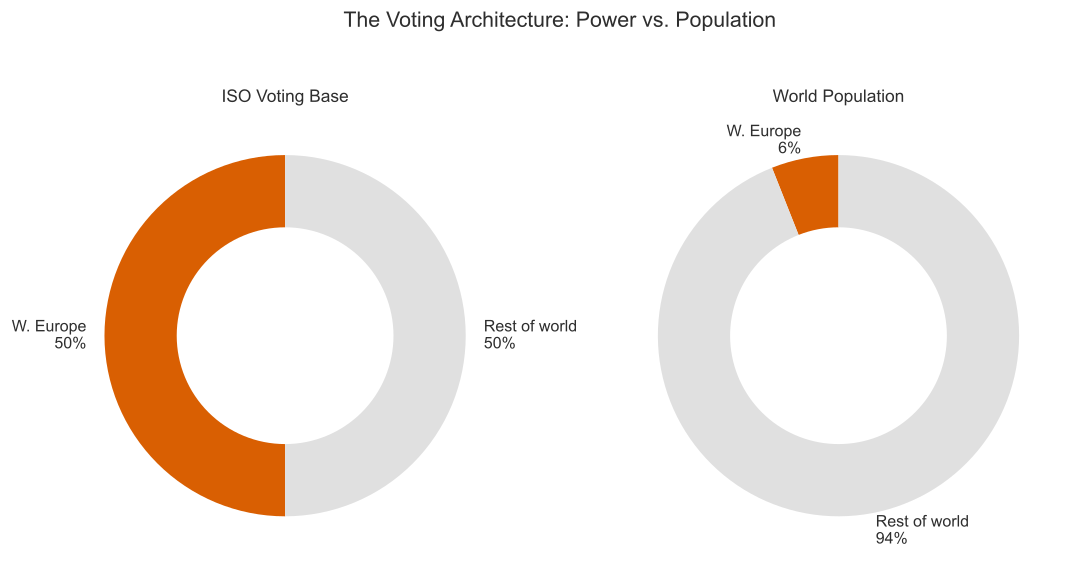
The result is a regulatory ecosystem in which the preferences of a few rich economies become the baseline for global commerce. A European Parliament resolution on chemical safety can cascade, via an ISO committee, into a binding requirement for a textile factory in Dhaka. A Japanese industrial standard on robotics can become the template for an international norm that Indian manufacturers must then license and adopt. The process is not colonial in intent, but it is colonial in effect: the rules are made in the centre and imposed on the periphery, and the periphery pays for the privilege of compliance.
The corporate colonisation#
If the geopolitical imbalance is the bones of the system, the corporate presence is its muscle. Standards committees are officially composed of national delegations, but the individuals who sit in the Palexpo chairs are overwhelmingly drawn from private industry. In mechanical engineering technical committees, industry representatives account for over 80% of participants. The remaining 20% is split among academics, government officials, and a sprinkling of consumer and environmental groups. In some committees, the skew is even more pronounced. TC 207, the committee responsible for the ISO 14000 series on environmental management—the standards that determine how companies measure and report their carbon footprint, waste streams, and environmental performance—is a case in point. A full 40% of its participants are not environmental scientists or regulators but consultants, registrars, and standards‑body officials, many of whom have a direct commercial interest in the standards they write. They are, in effect, both rule‑makers and rule‑sellers.
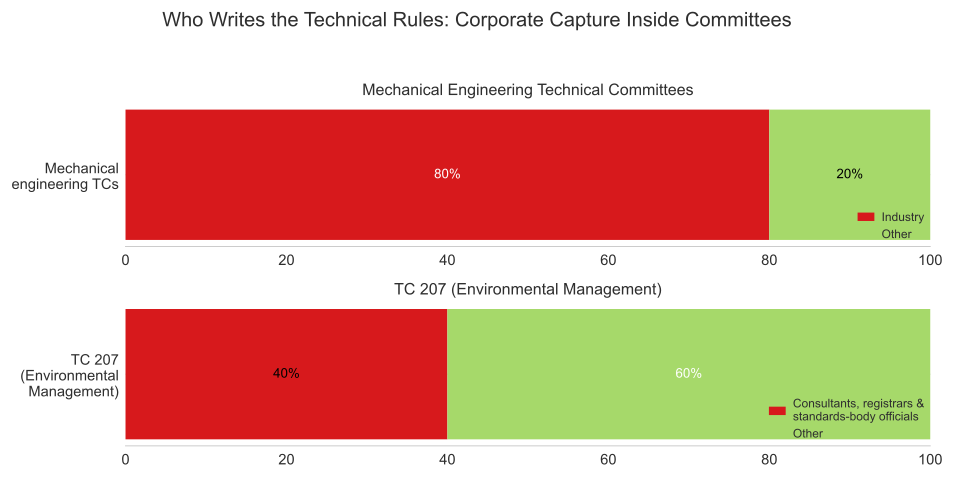
This convergence of regulatory and commercial interests is not necessarily corrupt, but it is certainly corrosive to the public interest. When a consultant helps draft a standard that will require companies to hire consultants to interpret and implement it, the line between public good and private rent blurs. When an equipment manufacturer sits on the committee that decides which testing method will be mandatory, the resulting standard often specifies a proprietary machine that only a handful of firms produce. The standard becomes not just a technical specification but a distribution mechanism for licensing fees.
The pharmaceutical and medical‑device sectors offer some of the most expensive examples. A CE marking for a simple electronic device may cost $400–$800; for a medical device requiring a notified body’s involvement, the cost rises to $13,000–$25,000 or more. Much of that cost flows not to safety testing but to the administrative apparatus of certification—the accredited bodies, the technical file reviews, the periodic audits. The standard is the entry ticket, and the ticket‑sellers have a strong incentive to keep the price high and the rules complex.
The delegate gap in human terms#
David Mwangi, the Kenyan engineer at the Geneva meeting, illustrates what the numbers mean in practice. His bureau, the Kenya Bureau of Standards (KEBS), has a mandate to protect consumers, promote trade, and participate in international standardisation. It has a staff of a few hundred, a budget that would barely cover the catering at a European standards conference, and responsibility for thousands of standards across every sector of the economy. When Mwangi travels to Geneva—a rare event, funded this time by a German development grant—he is expected to cover a dozen committees, read hundreds of pages of technical documentation, and somehow represent Kenya’s interests against delegations from Germany that number 20 specialists.
“The pace is too fast,” he says. “Between meetings, the work happens by email, in English, with technical jargon that assumes you have been working on this specific topic for years. If you miss one meeting, the draft has moved on. If you cannot afford the software to open the CAD files, you are excluded. The system is designed for full‑time participants. For us, it is a side task.”
Mwangi’s experience is echoed across the developing world. The Ethiopian Standards Agency has fewer than 100 registered auditors for the entire country; Germany has 12,000. The Seychelles Bureau of Standards recently acquired a single ion chromatograph—a machine essential for testing water and food contaminants—at a cost of €69,620, paid for by the European Development Fund. Without that one machine, all samples would have to be sent to laboratories in Mauritius or South Africa. “We are grateful for the equipment,” the bureau’s director told a local newspaper. “But we should not have to rely on aid to meet standards that other countries designed without consulting us.”
The absence of developing‑country voices is not merely a fairness issue. It means that standards are written without adequate consideration of the conditions in which most of the world’s producers operate. A food‑safety standard that assumes continuous cold‑chain logistics—ubiquitous in Europe, rare in much of Africa—can exclude thousands of small farmers without any measurable improvement in consumer safety. An electromagnetic compatibility standard that mandates testing in a chamber that costs $1 million effectively reserves the market for firms large enough to own one. The standards are presented as neutral, but they encode assumptions about infrastructure, capital, and institutional capacity that are deeply political.
The revolving door and the capture of TC 207#
To understand how deeply the commercial interest has penetrated the standards apparatus, it is instructive to follow the career of a typical standards professional. Dr. Anna Larsen (not her real name) began her career as an environmental scientist at a Norwegian research institute. She joined the Norwegian delegation to TC 207, the ISO environmental management committee, in the early 2000s, contributing to the revision of ISO 14001. After a decade, she left the institute to become a senior consultant at a global certification firm, helping companies implement the very standards she had helped revise. She now charges €2,500 a day for her expertise, and she occasionally returns to TC 207 meetings as a representative of an industry association.
Larsen’s trajectory is entirely legal and, by the norms of the standards world, unremarkable. Yet it illustrates the deep entanglement of regulatory and commercial functions. The people who write the rules are often the same people who profit from their implementation. And the people who profit from implementation have a vested interest in rules that are complex, frequently revised, and enforced through proprietary methods. A simple standard that a farmer can understand and verify with a $10 test kit is, from the perspective of the certification industry, a lost revenue stream. A complex standard that requires an annual audit by an accredited third party is a perpetual annuity.
TC 207’s composition makes the conflict transparent. With 40% of its participants drawn from the ranks of consultants, registrars, and standards‑body officials, the committee looks less like a regulatory body and more like a trade association for the compliance industry. When it debated the revision of ISO 14001 in 2015, one of the most contentious issues was whether to require third‑party certification. The requirement was retained, and the global market for environmental management certification—worth billions of dollars—continued to grow. The developing‑country delegates who argued for a self‑declaration option, citing the prohibitive cost of third‑party audits for small firms, were outvoted.
Historical continuities#
The standards cartel is new in its technical sophistication but old in its logic. The colonial powers of the 19th century used standards—weights and measures, electrical systems, railway gauges—to integrate their empires and exclude rivals. The British insisted on the imperial gauge for railways across India and Africa; the French mandated the metric system in their colonies. After decolonisation, the newly independent states inherited these standards and the industrial ecosystems built around them, locking them into relationships of technological dependency that endured for decades.
Today’s standards regime operates through consent rather than coercion, but the dependency it creates is no less binding. A country that adopts European food‑safety standards must buy European testing equipment, hire European‑accredited auditors, and follow European‑set revision cycles. It is not forced to do so; it chooses to, because the alternative is exclusion from the European market. But the choice is between compliance and poverty, and for most exporters that is no choice at all.
In the next generation, this dependency will extend into the digital and green economies. The European Union’s Carbon Border Adjustment Mechanism (CBAM) will require exporters of aluminium, steel, fertilisers, and cement to verify their embedded emissions using methodologies designed in Brussels. Mozambique, which sends 90% of its aluminium to the EU, will have to comply or lose its main market. Egypt’s fertiliser industry faces a similar reckoning. The standards for carbon accounting are being written now, in committees where African participation is minimal. The pattern repeats: those who will bear the cost have the least say in the design.
The gatekeepers’ logic#
The standards system, for all its flaws, is not a simple racket. The engineers and scientists who populate its committees are mostly well‑intentioned. They believe in the value of standardisation, and they can point to genuine public goods: safer products, more efficient supply chains, improved environmental performance. The problem is structural. A governance system that concentrates agenda‑setting power in a few rich countries, that allows the regulated to dominate the drafting rooms, and that imposes compliance costs without compensation will tend to produce standards that serve the interests of the incumbents, however pure the motives of individual participants.
The gatekeepers understand this logic intuitively. A senior ISO official, speaking off the record, acknowledged the democratic deficit but argued that it is a function of capacity, not design. “We would love more African participation,” he said. “We offer travel grants. We run capacity‑building workshops. But we cannot force countries to attend.” This defence is both true and disingenuous. Travel grants are small and few; capacity‑building workshops teach developing countries how to implement standards, not how to shape them. The deeper issue—the concentration of secretariats, the pace of work, the dominance of English, the assumption of full‑time engagement—is never addressed.
In Thika, Josephine Wanjiku knows nothing of ISO committees or voting architecture. But she knows that the certificates piling up on her desk were written by people who have never walked through an avocado orchard, who do not know the cost of a litre of diesel for the generator that powers the cold room, who cannot imagine what it means to spend a year’s income on a piece of paper that says your fruit is clean. “They think we are dirty,” she says. “They think we need to be inspected. But we are just small. And small, to them, is suspicious.”
The committee kings would not recognise this description. They would point to the rigour of their technical deliberations, the consensus‑based process, the opportunities for public comment. Yet the outcome is exactly as Wanjiku perceives it: a system that treats smallness as a defect and poverty as a risk, and that charges the poor for the privilege of proving themselves worthy of a market they helped to build.
In the next article, we will follow the money from the committee room to the farm gate, tracing the certification tax that turns standards into a regressive levy on development.