
On a humid morning in Ghana’s Volta Region, Comfort Agyapong watches a Dutch auditor in a white lab coat swab the surface of her mango drying racks. The auditor, flown in from Amsterdam at a cost of €1,200 for the visit alone, is collecting samples for a microbiological test that will determine whether Agyapong’s dried mangoes can enter the European market. The test will cost another $2,500. Agyapong has already spent $12,000 this year on organic certification, traceability software, and a GlobalG.A.P. audit. Her total compliance bill, before a single kilogram of mango is shipped, will approach $20,000—roughly ten times Ghana’s annual per‑capita income. “The mangoes are good,” she says, gesturing at the fruit drying in the sun. “The problem is the papers.”
Agyapong’s predicament is shared by thousands of small and medium exporters across the developing world, and it exposes the central mechanism by which technical standards extract rent from the poor. The cost of compliance functions as a regressive tax—a fixed, upfront levy that is unrelated to a firm’s size, profit, or production volume. Unlike a customs duty, which is proportional to the value of the shipment and collected by a public authority, the certification tax is collected by a sprawling private industry of auditors, testing laboratories, consultants, and equipment vendors, most of them based in the rich countries that mandate the standards. The system has grown so large and so lucrative that it now constitutes an invisible infrastructure of extraction, draining capital from the enterprises least able to afford it and transferring it to some of the world’s most sophisticated service economies.
The itemised bill#
To grasp the scale of this tax, it is useful to itemise it. For a typical African exporter of fresh or processed food, the compliance package required to access the European market can be broken into distinct components. Organic certification, which must be renewed annually by a third‑party body accredited to EU standards, costs between $8,000 and $15,000. The GlobalG.A.P. standard for good agricultural practices, which has become a de facto requirement for many European retailers, adds $10,000 to $25,000 per farm. Traceability systems, which track produce from the field to the shipping container and increasingly rely on digital platforms sold by European software companies, run from $3,000 to $8,000. Laboratory testing for microbiological contaminants, heavy metals, and pesticide residues—required per batch, not per season—costs between $2,000 and $5,000 each time.
These are not optional investments in quality improvement; they are mandatory tickets to market entry, and they are entirely dissociated from whether the product itself is safe or good. Agyapong’s mangoes are grown without synthetic pesticides, dried in hygienic conditions, and inspected by Ghana’s Food and Drugs Authority. But the European buyer will not accept a Ghanaian government certificate. They require a certificate from a European‑accredited body, and that body charges European prices. “It is as if we must pay a foreign company to tell our customer that we exist,” Agyapong says.
The cumulative cost, for a single product line, ranges from $16,000 to $34,000 per year. For an exporter with multiple products—mangoes, pineapples, coconut oil—the bill multiplies. And it does not end with the first certification. Standards are revised constantly, each revision bringing a new audit cycle, new documentation requirements, and often new equipment. The WTO’s Technical Barriers to Trade notifications have risen by over 6% annually; ISO alone issued 1,533 new standards in 2024. For a firm like Agyapong’s, which employs 40 women from the surrounding villages, the certification treadmill consumes a growing share of revenue, squeezing margins that were already thin.
The auditor chasm#
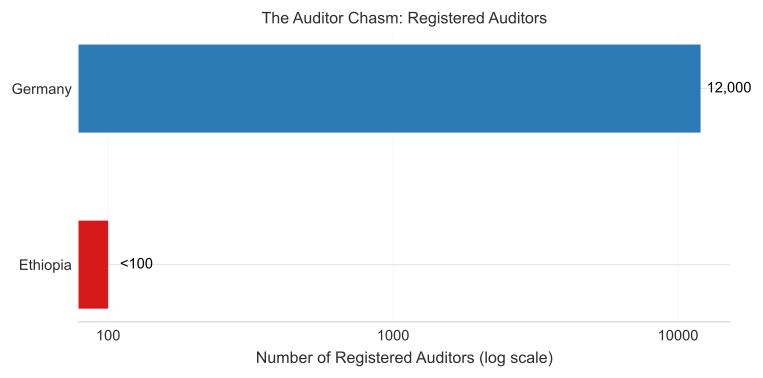
Why must Agyapong pay a Dutch auditor to inspect her mango racks? The answer lies in a structural asymmetry that is as profitable as it is persistent: the global distribution of accredited certification bodies and qualified auditors is staggeringly lopsided. Germany has over 12,000 registered auditors. Ethiopia, a country of 130 million people with a large and growing agricultural export sector, has fewer than 100. In Ghana, the number is only slightly higher. When local auditors do not exist or are not recognised by the importing country’s accreditation system, the exporter must hire a foreign firm.
The foreign auditor is not merely expensive. The daily fee—often $250 to $500—covers time spent travelling, inspecting, and writing reports, but it also reflects the scarcity of the credential. That credential is itself a product of a system in which the standards for auditor training, examination, and accreditation are set by bodies in high‑income countries. An Ethiopian engineer cannot simply hang out a shingle as a GlobalG.A.P. auditor; she must be trained by an accredited training provider, which is almost always based abroad, in a language that is not her own, at a cost that her bureau or employer can rarely afford. The result is a self‑reinforcing monopoly: rich countries produce the auditors, poor countries pay for them, and the fees flow north.
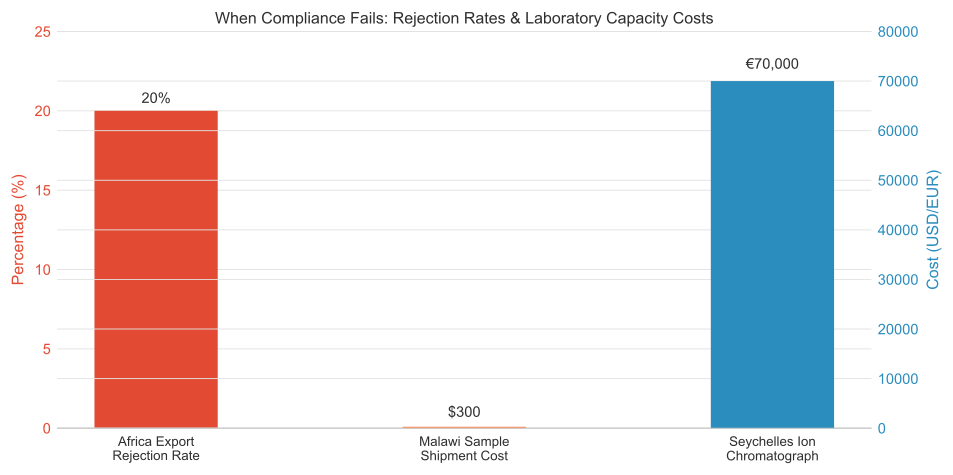
The auditor chasm extends to laboratory testing. The Seychelles Bureau of Standards recently acquired a single ion chromatograph—an instrument essential for testing pesticide and heavy‑metal residues—at a cost of nearly €70,000, funded by the European Development Fund. Without it, all samples would have had to be sent to Mauritius or South Africa at a cost of around $300 per shipment, plus weeks of delay that fresh produce cannot tolerate. Malawi’s exporters face a similar predicament, routinely sending samples abroad for certification. Kenya’s Bureau of Standards spent KES 67 million (about $519,000) on three new instruments, with donor support, simply to perform a fraction of the tests required for EU market access. The equipment, of course, was manufactured in Europe. The technical assistance to operate it came from European experts. The entire compliance chain—standards, testing, certification, inspection—is an export industry for the developed world, and developing‑country producers are its captive customers.
The regressive structure#
A tax is regressive when the poor pay a higher proportion of their income than the rich. By that definition, the certification tax is deeply regressive. A multinational food processor with factories in six countries can spread its compliance costs over millions of units, hire an in‑house regulatory team, and negotiate long‑term contracts with certification bodies. For a company like Unilever or Nestlé, the cost of a GlobalG.A.P. audit is a rounding error. For a cooperative of 40 Ghanaian mango farmers, it is an existential expense, equivalent to a significant fraction of annual revenue. The tax is also regressive across countries. Upper‑middle‑income economies like South Africa or Thailand have developed domestic certification industries that can serve their exporters at lower cost; the poorest countries, especially in sub‑Saharan Africa, remain dependent on foreign providers. The compliance burden thus widens inequality not only between rich and poor countries but among developing economies themselves.
The UN Conference on Trade and Development (UNCTAD) captures the aggregate effect in its May 2026 Global Trade Update: non‑tariff measures now impose higher export costs than tariffs for 88% of countries, and the least‑developed countries lose roughly 10% of their exports to G20 markets simply because they cannot meet NTM requirements. The cost equivalent of these measures, especially when they are not properly notified, can reach 28%—a tariff rate that would be considered scandalously high in any modern trade negotiation. Yet the political salience of a 28% tariff, announced in a budget and debated in parliament, is entirely absent when the same burden is imposed through a certification requirement buried in a technical directive.
The certification industry#
The certification tax is collected by an industry that has grown from a niche technical service into a global behemoth. The market for testing, inspection, and certification (TIC) services was valued at over $250 billion in 2024, and the largest firms—SGS, Bureau Veritas, Intertek, TÜV, DNV—are among the most profitable companies in the business‑services sector. Their growth has been fuelled by the very proliferation of standards that this series has documented: each new regulation, each revised standard, each additional audit requirement represents a new revenue stream.
These firms are not passive recipients of regulatory demand; they are active participants in the standards‑setting process. As the earlier investigation into committee composition revealed, consultants, registrars, and standards‑body officials make up 40% of the participants in TC 207, the ISO committee on environmental management. The people who write the rules are often the same people who profit from their enforcement. A requirement for third‑party certification, rather than a simple self‑declaration, can mean the difference between a one‑time compliance cost and a perpetual audit annuity. And because the auditors are also the experts, they are consulted when standards are revised, creating a feedback loop in which complexity begets demand for their services, which begets further complexity.
The industry defends its role by pointing to the public benefits of independent verification. Without third‑party audits, they argue, standards would be unenforceable, consumer trust would erode, and the entire edifice of international trade would be undermined. There is truth to this. Independent certification has caught genuine problems, from contaminated food to counterfeit electronics. The question, however, is whether the current system is efficient and fair, or whether it has been captured by the interests of the certification industry itself. The evidence points toward capture. A system that costs a Ghanaian exporter $20,000 for a piece of paper while delivering auditors who charge $500 a day but cannot be replaced by equally competent local professionals is a system that serves its providers better than its users.
The cost of exclusion#
The regressive structure of the certification tax has a particularly cruel feature: it penalises the poor for being poor. Food‑safety standards are based on the precautionary principle, which assumes that risk is present until proven otherwise. For a large, well‑capitalised firm with a track record of compliance, the burden of proof is manageable. For a small, unknown producer in a country with weak regulatory infrastructure, the burden is far heavier. The exporter must prove a negative—that her mangoes do not contain a banned pesticide, that her drying racks are free of a particular bacterium—and she must do so repeatedly, with expensive tests, because her word is not trusted.
The consequences of failing to meet this burden are severe. UNCTAD data suggests that African food exports face a rejection rate of around 20% due to non‑compliance with quality and safety regulations. A rejected shipment represents not just lost revenue but destroyed product, ruined relationships with buyers, and a damaged reputation that can take years to rebuild. The fear of rejection drives exporters to over‑comply, purchasing certifications they may not need, duplicating tests, and hiring consultants to navigate the regulatory maze. Each additional layer of precaution adds cost, and each added cost reduces the competitiveness of the product. The standards that were designed to protect consumers end up protecting incumbent producers in rich countries, who can afford the compliance overhead, while locking out exactly the new entrants who could bring competition and lower prices to the market.
The psychological toll#
The compliance tax also exacts a psychological cost that numbers alone cannot capture. Farmers and processors who have invested years in building a business, mastering their craft, and earning a local reputation for quality find themselves infantilised by the standards regime. They are told, in effect, that their own knowledge counts for nothing; only the foreign auditor’s stamp of approval has value. The experience is humiliating, and it breeds a corrosive cynicism about the fairness of the global trading system.
“We have been growing mangoes here for generations,” says Comfort Agyapong, standing in the shade of a tree that her father planted. “We know when the fruit is ripe. We know how to dry it so it stays sweet. But the man from Holland, he does not eat mangoes. He does not know our climate. He does not speak our language. Yet he is the one who decides if our mangoes are safe. How did this happen?”
The answer, as the previous articles in this series have shown, is that the standards system was built without the participation of people like Agyapong, and it is sustained by interests that profit from her exclusion. The committee that wrote the GlobalG.A.P. standard did not include a single African smallholder farmer. The laboratory that tests her mangoes is accredited by a European body that has never set foot in Ghana. The auditor who inspects her racks is paid with money that could have employed a dozen local agronomists.
The lost opportunity#
The certification tax is not merely a burden; it is a massive misallocation of resources. The $20,000 that Agyapong spends on compliance could have bought a refrigerated truck, built a new drying facility, or trained 50 farmers in integrated pest management—investments that would genuinely improve the quality and safety of her products. Instead, the money flows into a compliance infrastructure that produces little or no real improvement in the product itself, only a documentary trail that satisfies a distant bureaucrat’s definition of safety.
UNCTAD estimates that improving transparency in non‑tariff measures could reduce trade costs by 19%. Regulatory cooperation—mutual recognition of standards, shared accreditation, harmonised testing protocols—could cut NTM costs by 30–40% in African agriculture and manufacturing. These are enormous potential savings, equivalent to billions of dollars that could be redirected from certification middlemen to productive investment. Yet the governance of the standards system, controlled by those who benefit from its complexity, has been slow to embrace such reforms. Mutual recognition agreements between African and European accreditation bodies remain rare. The cost of ISO membership and participation, while modest by rich‑country standards, is prohibitive for the poorest economies. The standards system talks of inclusiveness, but its fee structure ensures that the toll‑gate remains firmly in place.
An agenda for change#
The certification tax is not a natural disaster; it is the product of institutional design, and it can be redesigned. Several practical steps could begin to shift the balance. First, rich countries could commit to recognising the certificates issued by accredited bodies in developing countries, rather than insisting on their own national accreditation chains. Mutual recognition is a long‑standing principle of the WTO’s Agreement on Technical Barriers to Trade, but it remains honoured mainly in the breach. Second, development finance institutions could invest heavily in building local certification capacity—training auditors, equipping laboratories, and subsidising the initial accreditation costs for indigenous firms. The African Organisation for Standardisation has made halting progress on this front, but its budget is a rounding error compared with the revenues of the global TIC industry.
Third, the governance of standards bodies could be opened to genuine developing‑country participation, including funding for travel and technical support, weighted voting reform, and mandatory public‑interest representation on key committees. If the rules are to be seen as legitimate, those who must follow them must have a hand in their making. Finally, the WTO’s transparency mechanisms—already shown to have the potential to cut trade costs by 19%—could be made mandatory and properly funded, ensuring that every new standard is notified, translated, and accessible to the exporters who must comply.
None of these reforms would abolish the need for certification. Food safety is not negotiable, and consumers have a right to know what they are eating. But they would begin to address the regressive, extractive nature of the current system, converting the certification tax from a private levy on the poor into a genuine investment in quality that benefits producer and consumer alike.
In Thika, Josephine Wanjiku has heard promises of reform before. “Every conference, they talk about helping small farmers,” she says. “Then the next standard comes, and it costs more than the last one. I will believe they are serious when the paper costs less than the avocado.”
The next article in this series will examine the most sophisticated mechanism of extraction yet devised: the fusion of patents with mandatory technical standards, and the hidden royalty pipeline that flows from the global South to the North every time a product complies with a standard.