A comprehensive exploration of how technological innovation is shaped by path dependency, structural lock-in, and biomimicry as a pathway to more resilient design systems.
Examining how technological innovation is constrained by path dependency and structural lock-in, using QWERTY keyboards and other examples to illustrate why superior technologies often fail to displace incumbents.
The Mongol massacres weren't random violence. They were calculated psychological operations designed to minimize resistance and Mongol casualties. Here's the disturbing logic behind history's most effective terror campaign.
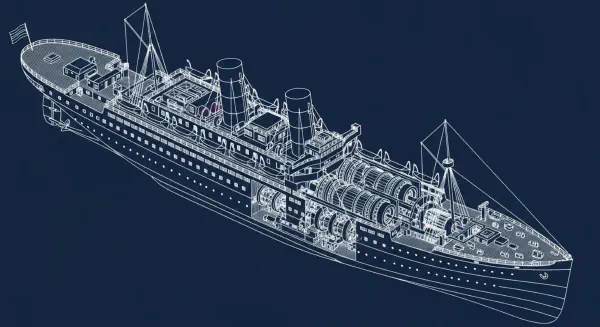
The early 20th-century steamship was a transitional industrial organism that achieved transoceanic scale by integrating high-density manual labor with a sophisticated 'closed-loop' thermodynamic system. Quantitative analysis reveals a critical dependence on thermal recycling, where steam volume expanded sixteen-hundredfold to drive quadruple-expansion engines before being condensed to prevent the catastrophic loss of fresh water. The structural mechanism of this integration was a steam-based nervous system that synchronized propulsion, navigation, and life support across a five-hundred-foot riveted steel hull. This analysis requires one post to synthesize the ship's mechanical and logistical unity.
The construction of the St. Lawrence Seaway promised economic prosperity but unleashed ecological disaster through invasive species like sea lampreys and alewives.
The final exploration of how Uthman's modesty and Ali's chivalry became tragic vulnerabilities as the Islamic state evolved from a religious mission into a geopolitical empire.
An analysis of Abu Bakr's 'admiration for heroism' and Khalid ibn al-Walid's 'nature of the soldier'—two distinct psychological keys that united to preserve the early Islamic state.
An exploration of Abbas Mahmoud al-Aqqad's psychological method for understanding historical leadership through the concept of the ''Key to Personality''.
An introduction to Abbas Mahmoud al-Aqqad's 'Key to Personality' method and how it transforms the study of historical leadership through psychological analysis.