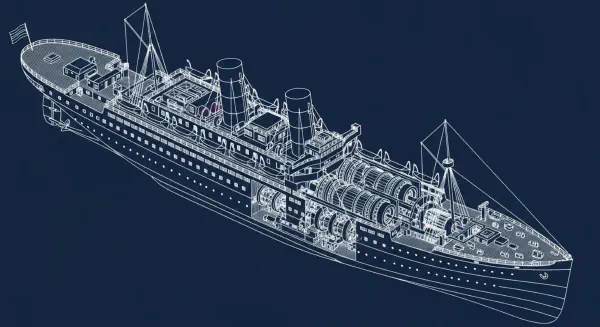
The Industrial Organism: Mechanics of the Early 20th-Century Steamship
·1474 words·7 mins
The early 20th-century steamship was a transitional industrial organism that achieved transoceanic scale by integrating high-density manual labor with a sophisticated 'closed-loop' thermodynamic system. Quantitative analysis reveals a critical dependence on thermal recycling, where steam volume expanded sixteen-hundredfold to drive quadruple-expansion engines before being condensed to prevent the catastrophic loss of fresh water. The structural mechanism of this integration was a steam-based nervous system that synchronized propulsion, navigation, and life support across a five-hundred-foot riveted steel hull. This analysis requires one post to synthesize the ship's mechanical and logistical unity.