

Systems Thinking

The Calculus of Cataclysm: How Economies Absorb, Adapt, and Evolve
·245 words·2 mins
This series traces how economies absorb, adapt, and evolve through 'development blocks' where technologies and logistics create new worlds, but policy shapes their direction and social impact.

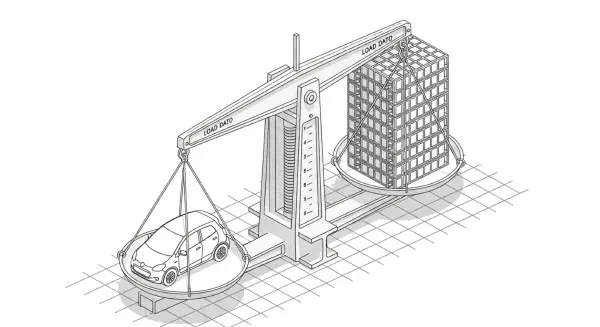
The Weight Penalty
·535 words·3 mins
Why mass compounds against itself in every transport system — and what the Mass Amplification Factor reveals about the engineering limits of the electric vehicle.

The Plastic Externality
·958 words·5 mins
Every tonne of plastic produced carries environmental and health costs that no producer has ever paid. The Plastic Cost Coverage Ratio compares what producers actually pay to the full external cost their production imposes on the environment and on human health — consistently between 0.01 and 0.05, meaning plastic producers capture less than five cents in environmental liability for every dollar of damage their products create.
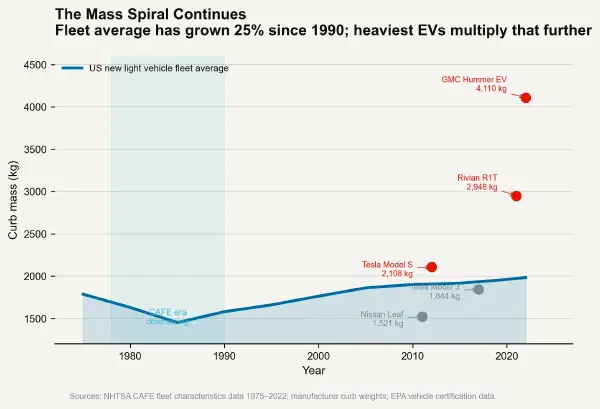
The Weight Penalty – Part 4: The Mass Budget Discipline
·1335 words·7 mins
Contrasts aerospace mass budget culture — where mass is the primary design currency — with ground transport engineering, demonstrating what the discipline of mass management achieves when enforced.
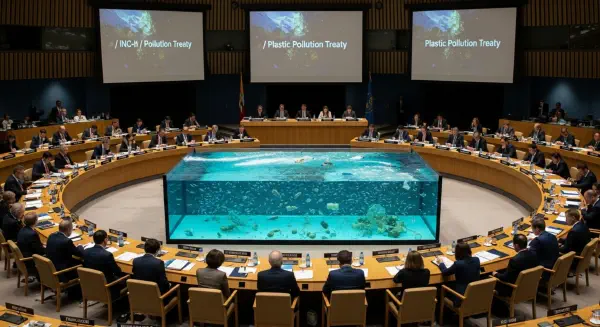
The Plastic Externality, Part 4: Who Pays?
·1306 words·7 mins
Audits the EU Plastics Strategy, Extended Producer Responsibility regimes, and the UN Global Plastics Treaty INC process against the Plastic Cost Coverage Ratio, demonstrating the gap between policy ambition and industrial accountability.
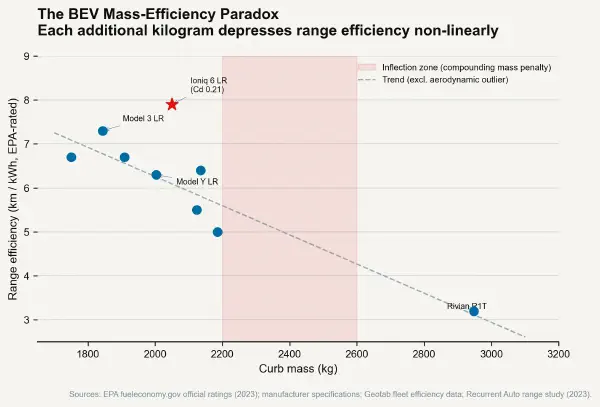
The Weight Penalty – Part 3: The EV Mass Paradox
·1289 words·7 mins
Applies MAF analysis to reveal that above approximately 2,400 kg total vehicle mass, adding battery capacity reduces net range per unit of additional battery mass — placing the 10 best-selling BEVs at or near this inflection point.

The Plastic Externality, Part 3: The Microscopic Crisis
·1389 words·7 mins
Documents the discovery of microplastics in human blood (2020) and nanoplastics in human brain tissue (2023), and applies precautionary arithmetic to the incomplete and contested epidemiology of plastic particle health effects.
The Weight Penalty – Part 2: The Structural Mass Spiral
·1306 words·7 mins
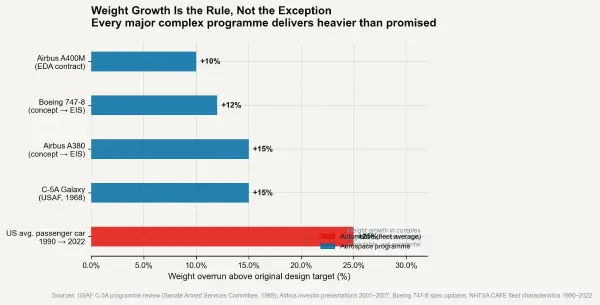
Documents how aircraft, ships, and ground vehicles consistently exceed design-phase weight targets because structural reinforcement requirements compound the original load-bearing specification.